
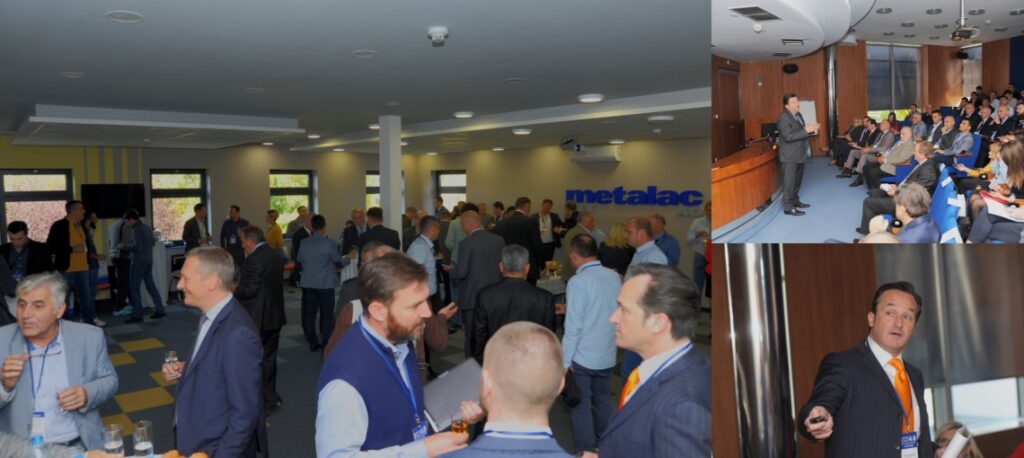
IPG GROUP actively contributed in showing benefits and importance of Industry 4.0 initiatives by demonstrating best practice examples and success cases from German speaking area.
“Future has already started and it is not a question whether we want to go towards it, because who is not willing will disappear”, “We urgently need a strategy for Industry 4.0 and appropriate experts, knowledge and competencies since work will be done by people and not technology itself”, “It is of utmost importance that on the same path we have state, businesses and academic community”. Those were just a few of key messages that were communicated during the panel discussion at Metalac Group.
Representatives of different domains of Serbian economy and society participated on the panel, including those from Chamber of Commerce, Mechanical Engineering University, Ministry of Economics, international experts, Metalac Group as well as from other Serbian companies. All the participants emphasized the importance of the panel of this kind as well as the topic of Industry 4.0, which is seen as one of the keywords of 21. century. The goal of the panel was to create general understanding through open discussion about priorities, challenges and opportunities in creating strategic directions for Industry 4.0 implementation.
After 2008, things dramatically changed. Industry 4.0 brought about a massive bounce in the world of opportunities. New technologies brought applications significantly influencing traditional economic practices. Companies changed their behaviors to focus on customers, to automatize processes since it is becoming increasingly hard to keep employees and to connect with others and decrease costs. In Industry 4.0, it became important to think digitally. Leading countries recognized this significance of Industry 4.0 and already started with their digital transformation initiatives. Countries like Switzerland, Germany, USA, Japan already invested or planned to invest, more than dozens of billions of euros in digital transformation by 2020 to keep and enhance their leadership position. However, Serbia has even not yet defined its strategy in this area and has to change and do its homework to keep up with developed industries.
By presenting experiences and best practices in Industry 4.0, Carsten Vollrath, CEO IPG Group, emphasized that companies that are global leaders today gained advantage primarily because they started early with a strong focus – some even 10 years ago.
Carsten Vollrath emphasized:
- “For the digitalization of industry a close alliance among research, academia, economics, politics, industry associations and economic unions is needed, but also including the development of competencies, skills and business models – since the job is executed by people and not technologies.”
- “Serbia has to primarily define the scope of actions, then identify industrial partners and key groups of small and medium enterprises and network them with universities, economic associations, experts and consultants through, so-called, digital laboratories. Through those laboratories, with collaborative work and networking with international partners, a demonstrative model of digital transformation would be developed in 6 to 9 months.”
- “In the transformation process, Serbia should not copy, but create its own path!”
The panel discussion showed that the challenge for implementation of Industry 4.0 is not new technologies and terms that come along: Internet of Things, Big data, Edge computing, 5G, Blockchain, Artificial intelligence, Virtual reality, Augmented reality, and so on. But more so, participants agreed that main challenges are well summarized in key points presented by Mihailo Vesović from Serbian Chamber of Commerce: ”The future has already begun and who does not take that train will disappear. State, academia and economy have to be together, build the strategy of new industrialization and develop the new business culture with above-average skills and competencies.”