
Carsten Vollrath, CEO of Swiss IPG Partners Group, reveals which challenges does digital transformation bring, how close Serbia is and how to catch up with developed economies.
REVOLUTION BRINGS SMART PRODUCTS
Knowledge, lack of implementation, and hesitancy of key stakeholders to adapt to new, digital environment are the main stumbling stones.
COMPANIES can decide on their own to go through digital transformation. In that case, companies would be left alone to cope with increasingly hard trial-and-error learning process. They cannot share knowledge in digital network. This approach would lead to an expensive, lengthy and inefficient transformation process. Without the intervention and strategic support from government, there will certainly be no full industry-wide digital transformation and its fast implementation. Both are important to catch up with developed economies.
This is how Carsten Vollrath, first man of the Swiss IPG Partners Group, consultant for transformation processes, answers on a question could business all alone, without state strategy, face with Industry 4.0 revolution. The Biggest players in the world have already went through digitalization. In Serbia new solutions, processes and knowledge implement only narrow circle of most successful companies.
The role of the state and its top-down approach will be to ignite the transformation in real economy, steer it to the right direction and lead to its faster implementation. The government, together with its economic associations like Chamber of Commerce, should promote digitalization to multiply number of companies willing to change and collect experiences, best practices. That is how it multiplies knowledge base. The government has to modernize its educational system to enable competences appropriate for Industry 4.0.
WHAT DOES INDUSTRY 4.0 AND NEW DIGITAL ERA MEAN?
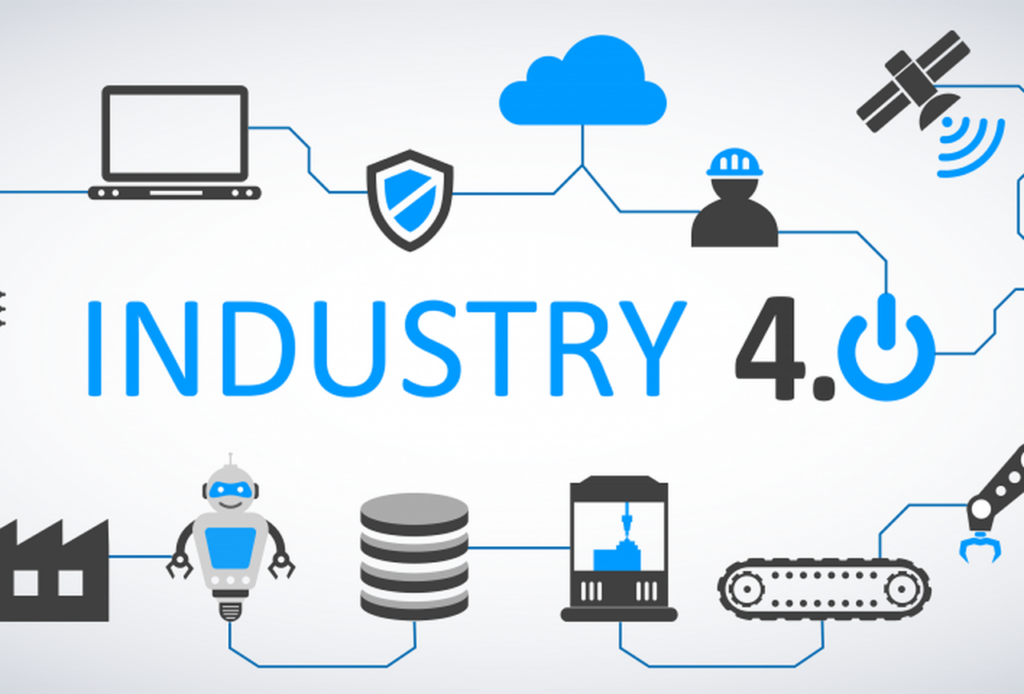
The first industrial revolution was characterized by mechanization through steam power, whilst the second brought mass production and assembly lines. The Industry 4.0 take what was started with the adoption of computers and automation in the third industrial revolution. By fundamental definition, Industry 4.0 uses cyber-physical systems. They are comprised of smart machines, storage systems and production facilities capable of autonomously exchanging information, triggering actions and controlling each other. It represents a new way how manufacturing processes are performed, and the output are smart products, services and solutions. New technologies bring potential to make factories significantly more efficient and productive, yet less wasteful. Industry 4.0 brings massive opportunities for companies and industries to position on a high-end level, bring high value adding products and services to the market and increase their revenue and profitability.
WHICH CHALLENGES DO THEY BRING AND WHAT IS THE BEST AND MOST EFFICIENT WAY FOR DEVELOPING COUNTRIES TO ADAPT?
As any other revolution, Industry 4.0 do not come independent of challenges, and they are, in case of developing countries, even bigger. Many developing countries have not yet fully reached the level of previous revolutions, so they have to do comparably more homework. This larger gap to fill is reflected in a need to perform restructuring programs, optimizations and thus set fundamentals to foster innovation. Our experience tells us that these preparations have priority to set solid grounds for companies’ proper functioning before thinking about Industry 4.0 systems deployment. In front of the companies that are ready for digitalization, challenges to its implementation still exist. And especially in the initial phase. The knowledge lack in its implementation and hesitancy of the key stakeholders to adapt to new, digital environment are the main stumbling stones. If we talk about Serbia, there is a significant focus on new industry, but it is necessary to come up with a comprehensive initiative plan and activity list for its widespread implementation in short term. The gap is significant. Although there are best practice examples of other countries, Serbia should not copy these cases. It has to learn and seek for its own path.
WHAT IS THE JOINT ROLE OF THE STATE, BUSINESS AND ACADEMIC COMMUNITY IN THAT PROCESS? HOW THE CONTRIBUTION OF EACH ONE INDIVIDUALLY CAN BE MEASURED?
If Serbia wishes to keep up with developed countries and develop industrial maturity with at a faster pace, it has to implement a “top-down” approach. Government should support its main economic associations, such as Serbian Chamber of Commerce, to play a leading guiding role in digitalization. Defining key points is just a small part of much larger approach that presumes deployment of a “digital network”. The “digital network” have to be comprised of 5 pillars of inter-connected partners. These are government, academia, science & technology, companies and specialized solution partners. This multidisciplinary network is key place of success where ideas, experiences and contacts are created, challenges overcome, competences built. Only the strong alliance of players with a lot of significant expertise can provide for desired and fast results. The stronger the “digital network” is, the higher the gains are for the whole Serbian economy as well as for each individual player in the alliance. Although this approach is rarely seen in developing countries, it is the key to incentivize the parties to contribute into a network and not to measure their individual contribution.

WHAT IS THE WAY CHAMBERS OF COMMERCE CAN ASSIST COMPANIES TO ADAPT TO NEW INDUSTRIALIZATION IN MOST EFFICIENT AND FASTEST WAY?
The role of economic associations, such as Serbian Chamber of Commerce, should be the key for digital transformation dissemination. Overarching approach is the key for widespread implementation of new industry. It means nurturing “digital network”. Second segment is promotion, raising awareness of benefits of digitalization. Third is setting standards & norms and fourth is knowledge collection and dissemination as well as provision of guidance. There is also cooperation with associations from other countries. Lastly, there is organization of digital laboratories. Those are real projects that demonstrate practical approach towards industrial digital transformation. They should be coordinated by Serbian Chamber of Commerce and developed by working groups of partners from academia, industry and consulting.
WHAT ARE THE DIGITAL LABORATORIES AND WHAT IS THEIR ROLE?
Digital laboratories represent projects for development of new products, services or manufacturing processes. Main idea is to work on an innovation gathering people with industry skills, digitalization experience and business knowledge. They jointly innovate value chain of the “anchor” company including its suppliers and customers. In a digital laboratory, Serbian Chamber of Commerce together with partners choose the most appropriate “anchor” company for digitalization. To be part of the project, the company has to fulfill several key requirements. It has to be well reputable and export oriented, has strategic focus on digital transformation and have adopted organizational structure accordingly. A starting point of digital laboratory is to be a role model for digital transformation. After pilot project is completed the knowledge gained can be adopted by other market players.
WHAT DOES THE STRATEGY OF NEW INDUSTRIALIZATION IMPLY?
The strategy for new industrialization should put much focus on an interplay between technology and human resources to maintain balance in production. It is a fact that traditional jobs based on a repetitive labor work will be obsolete in an era of automatized production. Thus, the core competences of human resources will change to favor effectiveness, creativity and innovation potential. A shade will be put on strong focus on efficiency. To foster the development, it is necessary to transform educational systems.
DIGITAL TRANSFORMATION BRINGS FEAR OF LOSING JOBS. IS THIS FEAR REASONABLE?
This question is not easy to answer since we are still in an early stage of the revolution process. Although it seems that computers and robots will take over jobs from human resources in the age of digitalization, the real case examples show completely opposite effect. Look at Switzerland, Germany and Austria as one of the most developed societies as good practice examples. These countries that are heavily investing and promoting digitalization do not have any issues with unemployment. Moreover, they lack human resources and are heavily depending on “import” of competent and skilled people. The digitalization only brings change in those competences and skills that are needed. Effectiveness, creativity as well as digital skills are seeked. It is necessary to open and motivate employees to constantly learn and build up skills.
COMPANIES THAT HAVE ALREADY ENTERED THE CIRCLE
There are companies in Serbia that have already successfully implemented some of the systems of Industry 4.0. Our experience tells us, these are only few rare, positive exceptions. We hope, with an introduction of digitalization initiative in Serbia, these exceptions will soon become industry standard. “Inmold plast”, Požega is producing high-quality tools for plastic and non-ferrous metals molding and IML robots. The company implemented centralized data base with features for fast document generation, automatic specification output and technological component provision all used as basis for production planning or subcontracting. “Telsonik”, Kać is a branch of global Telsonic Group headquartered in Switzerland. It provides ultrasonic technology solutions. The company implemented digital simulations package for testing of numerous geometric variations of sonotrodes. “Metalac”, Gornji Milanovac is producing cookware, boilers, sinks, packaging material, automotive parts, tools. The company developed ecommerce tool and open source Customer Relationship Management (CRM) system. In addition, the company sees digitalization as strategic direction and plans to develop a full-fledged digitalization business model.
This article was also published on NOVOSTI on October 30th, 2018
You can download the whole interview as an attachment on the bottom of this page.