


The world is rearranging itself: Asia and here especially China will be the winners, the “golden age” of the West is coming to an end, the US dominance is dwindling.
Over 50% of the world’s population now lives in Asia, only less than 5% in the US. A good 4 billion Asians, of which one third are Chinese, are increasingly demanding their participation in the world community. China’s visionary plans meet a largely haphazard West. Favored are companies that have adapted in time to these global changes and aligned.
The sun rises in the east and sets in the west
For most people unnoticed in this country, China launched its massive and impressive catch-up hunt almost 40 years ago. Over the past three decades, the Middle Kingdom has become the fastest growing economy in the world.
Under Deng Xiaoping, the scope for the private sector grew increasingly larger in the 1980s and foreign investment was promoted in so-called special economic zones. In the 1990s, Jiang Zemin proclaimed his reform of the socialist market economy and began privatizing state-owned enterprises on a large scale. In addition, he created high investment incentives for foreign direct investment and paved the way for China’s accession to the World Trade Organization (WTO). At the beginning of the new millennium, his successor Hu Jintao slowed down the privatization process, but nonetheless ensured that the growth path continued, for example, with an expansionary monetary policy and state-sponsored national champions.
At the end of 2012, the new and still topical leadership was installed at the 18th party congress. Since then the most powerful man in the country has been Xi Jinping, Secretary General of the Communist Party and at the same time President of China. He prefers the market economy and is committed to the reform and opening policy. In this year’s New Year’s speech, he emphasized this again, because only so progress can be achieved and the “Chinese dream” of a moderately affluent society can be realized. He is assisted by Prime Minister Li Keqiang, the country’s second most important ruler, who clearly stated in his report before the People’s Congress that China is committed to promoting economic globalization and protecting free trade. He also emphasized the importance of reducing overcapacity, handling heavily indebted state-owned enterprises and promoting new technologies.
But China not only has its five-year plans presented at the party congresses, but also a visionary plan for the next 30 years. Xi wants to make the country a prosperous, ecological high-tech nation. In doing so, he relies on a mix of state control and deregulation as well as an increasingly open economy. The goal is to become an innovation leader in all key enabling technologies by 2025, see energy production, e-mobility, aircraft, railway and shipbuilding, as well as robotics, cellular technology, medical technology and more. Expenditure on research and development is already higher than in the EU as a whole and is rising faster than in the US. The number of international patent applications is now higher than in Europe, USA and Japan together. At the international level, an intercontinental infrastructure network between Asia, Europe and Africa must be promoted as part of the new Silk Road. By the year 2049, ie the 100th anniversary of the founding of the People’s Republic of China, the country should be modern, strong and prosperous.
China is implementing visionary plans – West largely haphazard
But what about our future plans, our visions in Germany, in Europe or in the USA? Here there is practically gaping emptiness. Instead, issues such as over-indebtedness, Brexit, refugee, real estate, banking and financial crises were on the agenda. The discussions and massive delays, for example, on your own doorstep around major projects such as the Berlin airport, the Hamburg Elbphilharmonie, the Stuttgart train station or the expansion of the Munich S-Bahn trunk line not to forget. While we are proud to finally reach Berlin from the city of Munich, some 600 km away, by train in four hours, the Chinese high-speed train only needs half an hour more to travel more than twice the distance from Shanghai to Beijing. At the same time, the fare is significantly lower and the cleanliness and punctuality of the trains are exemplary.
We are missing out on urgently needed investments in our infrastructure, children and education as well as the massive promotion of already few sectors or technologies in which we are still world market leaders. At the same time, hundreds of millions of young and increasingly well-educated Chinese are entering consumption for the first time and are fueling the economy. Today’s corporate leaders, who were unable to receive adequate training in the years 1966 to 1980 due to the Chinese cultural revolution, are being replaced by academics with the best degrees. Poor state-owned enterprises, as well as the environment overcrowding companies in China, will gradually become a thing of the past, either through closure or privatization, combined with the professionalization of corporate governance.
Parallel to this is the strong political will of the Communist Party to assume more and more responsibility and leadership internationally. While US President Donald Trump takes numerous protectionist measures and feels comfortable with half the world, Xi Jinping committed to world trade. For example, the recent People’s Congress stated that the Chinese manufacturing market is to be fully opened up and market barriers for many sectors, such as finance, medicine and telecommunications, are further reduced.
Changing of the guard in the USA has already taken place
Twenty-five years ago, the German economy was about four times as large as the Chinese dollar on a US dollar basis. Today, its gross domestic product (GDP) is about four times larger than German.
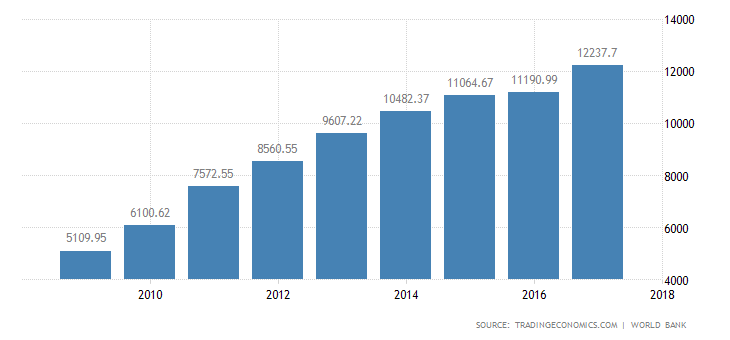
China has now become the second largest economy in the world at around $ 12,000 billion (USD), after the United States, with approximately $ 18,000 billion. It will quickly close the remaining gap with the US and then move quickly past the US. Within the next decade, the changing of the guard will take place officially. It should be noted, however, that currently in China 1 USD has a higher purchasing power than in the US, that is, the consumer can buy in China with 1 USD more than in the US. If these differences are correctly taken into account and thus the respective purchasing power adjusted GDP is considered, China is already today the world’s largest economy. Twenty-five years ago, China’s share of world GDP, adjusted for purchasing power, was still below 5%, today it is just under 20%, and the trend is rising. Over the same period, the USA has fallen from over 20% to 15%, with a downward trend.
The Gross Domestic Product (GDP) in China was worth 12237.70 billion US dollars in 2017. The GDP value of China represents 19.74 percent of the world economy. GDP in China averaged 1970.49 USD Billion from 1960 until 2017, reaching an all-time high of 12237.70 USD Billion in 2017 and a record low of 47.21 USD Billion in 1962.
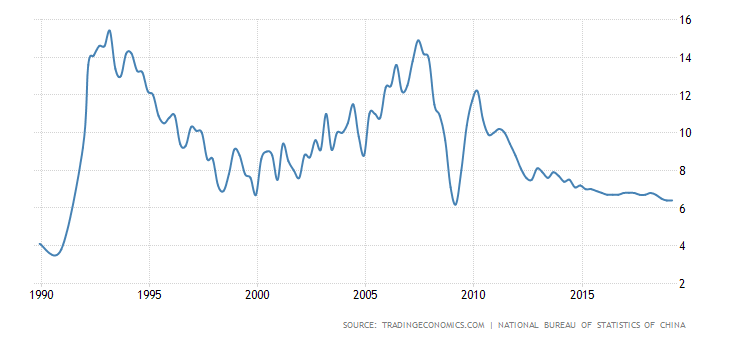
The Chinese economy advanced 6.4 percent year-on-year in the March quarter of 2019, the same pace as in the previous quarter but slightly above market expectations of a 6.3 percent expansion. Industrial output growth accelerated markedly and consumer demand strengthened amid government’s pro-growth policies, which helped stabilize sentiments rattled by trade dispute with the US. On a quarter-on-quarter basis, the economy grew 1.4 percent in the first quarter, compared to a 1.5 percent expansion in the previous period and matching market estimates. It was the weakest quarterly growth rate since the first quarter of 2016. GDP Annual Growth Rate in China averaged 9.52 percent from 1989 until 2019, reaching an all time high of 15.40 percent in the first quarter of 1993 and a record low of 3.80 percent in the fourth quarter of 1990.
China’s contribution to global economic growth has been around one-third in recent years. With exports worth $ 2,300 billion, China is the largest exporter in the world. The Middle Kingdom accounts for approximately 25% of global car sales and 50% of electric vehicle sales. Nearly a quarter of the world’s 500 largest companies come from China according to the latest list of the Fortune business magazine, and the trend is rising.
The current trade dispute between the US and China will not change anything important here. Total exports from China to the US account for just about $ 500 billion or 4% of the Chinese economy, less than China’s GDP alone will grow this year. Even if goods worth 100 billion or more are subject to punitive tariffs, this is rather small in relation to the size of the economies shown above. In addition, a penalty does not mean that these sales completely break away. For one thing, some consumers will continue to want to buy these goods despite price increases. On the other hand, China can devalue its currency as a backlash and promote affected companies and thus mitigate a price increase. And last but not least, China is increasingly looking for a bridge in Asia as well as in the direction of Europe and, in particular, Africa as well, in order to become even more independent from the USA in the future.
From the workbench to the research laboratory
With more than 6 million university graduates per year, including around 2 million engineers, more than a quarter of the world’s university graduates now come from the Middle Kingdom. In the future, the Chinese will also build, develop and export their own machines themselves. The country is evolving from a workbench to a research laboratory, from a model student to a teacher. There is money invested there, which we know in the Western world only in connection with the sovereign debt crisis. China is modernizing so impressively, step by step. Over the next few years, there will be more thousands of kilometers of new subway lines, including countless new subway stations. Modern container ports, airports and power plants are being built in large numbers. Tens of thousands of kilometers of autobahns and ten thousand kilometers of new railway connections – often high-speed connections – are being created. Many Western countries, on the other hand, are in the sovereign debt trap.
The current economic or world order – see World Bank, IMF or G7 or G8 as well as the UN, which was founded over six decades ago, no longer reflects the reality. At the end of 2013, for example, the summit of the 21 countries of the Asia-Pacific Economic Cooperation (APEC) in Bali impressively demonstrated how the world is rearranging itself. While US President Barack Obama had to detain himself at home in view of the impending US insolvency, China took the lead. For this time only at this conference, in the near future throughout the Asia-Pacific region. The core of this economic area, in which around 3 billion people already live today and which accounts for more than half of world trade, will define China in the future.
This text first appeared in the FIVV China-Report