

In the future, the success of companies will be decided by their internal cooperation.
Agility, transformation, disruption, ambidexterity, leadership and, of course, digitalization: A storm of new buzzwords is sweeping Europe. Triggered by the fourth industrial revolution, this storm quickly began changing the language of consultants, trainers, coaches and executives. Astonishing lectures, seminars and even courses of studies are being held, which allow employees and managers to “batten down the hatches and become fit for tomorrow’s working world". A world in which no one can currently tell what it will look like in the end.
Initial experiences, plausible theories, and clever approaches exist as well as the realization that no patent remedy will be available for the future’s working world. However, some things are already becoming apparent: The ability of companies to change continuously will become a decisive competitive strength. One thing is clear: The path will look different every time.
The ability to change as well as rethinking begins in the minds of managers.
It’s the people who drive innovation, bring organizations to life, and lead strategies towards success. They need specialized tools of the trade, the right attitude and a new form of leadership to be fully involved in the future - instead of standing helplessly alongside it all.
Therefore, ranging from management to team leadership, it becomes a crucial task of managers to develop their employees’ abilities and thus, the capability of their company to change and secure it in the long term. Managers are suddenly confronted with an entirely new scope of tasks.
In the first step, building up the ability to change means creating the necessary professional and social competence within the management team. It is the only way to successfully implement the organization’s development processes that were triggered by a change project.
One key to success is communication. That means far more than just beating around the bush rhetorically. The objective is to provide orientation in continuous dialog, and subsequently walk the talk.
For tomorrow’s companies, "emotional stability" will be just as important as financial stability.
As people, we have been able to establish ourselves in the working world. Hierarchies and careers, structures and processes may not always have been very convenient. However, for decades, they have provided stability. Employees, as well as managers, are sensing that this stability is beginning to fade.
So where will the urgently needed stability come from for them to have courage, strength and confidence for change in the future? What patterns will provide security to employees in the future and allow them to bond with “their” company? Cooperation that is based on clear values will have to ensure their confidence in the future.
This new confidence can only be provided by regular interaction with one another. Allowing the fear of uncertainty to give way to an awareness that change is something evident and positive - as it presents us with the chance to shape the future together. The prerequisite is: "Knowing what you’re up against, and how to get along with each other reliably."; this includes creating a collective understanding of leadership and cooperation - and continuously readjusting it.
On this basis, an enormously high degree of security is created for each employee and as a result, a stable foundation for the organization. This "emotional stability" forms a strong backbone for the company, and at the same time facilitates more flexibility and independent action.
Changes are great opportunities for organizations to learn from.
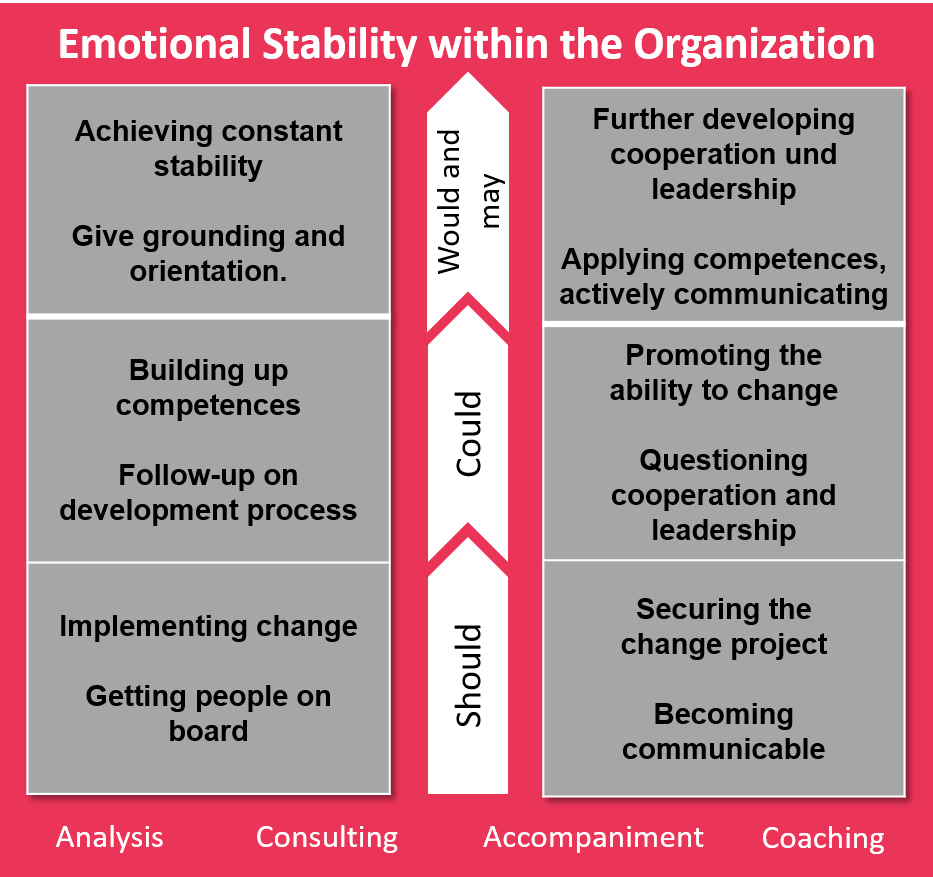
A change in strategy or structures and processes - and many people have to be convinced and gotten on board. You SHOULD change (see graphic). Surveys show that such projects often fail because of fundamental matters. These include an insufficient commitment on the part of top management, unclear objectives and visions, disagreement on the part of management and a lack of experience as to what matters during a change.
In addition to typical commercial and organizational homework, and above all, one thing counts: to be able to communicate, which is a core task for the project team and managers. Communication during change requires one step in particular: credible, trust-building dialogue between management and employees. The communications department can support you in accomplishing this task; by helping to align communication and interaction precisely with the company and the respective target groups.
You can't help but dare something new. New approaches make it possible to break old patterns, set new standards and persuade employees to work together. Professionally accompanied, and with the right impulse at the right time, not only the success of the change project itself can be secured. It is advisable to use these at the same time so that the organization can learn how to change actively. This learning also includes conveying change expertise.
It is essential to be familiar with the maturity level of the organization to find the right starting point. This process also includes correctly assessing the leadership and communication skills of all management levels. Often it is that a straightforward question, asked at the right moment, causes excitement and a change of perspective among managers during a strategy workshop: "How do we have to work together in the future, and what does our leadership role look like if we are to succeed?” (see graphic: COULD)
Rethinking is a gigantic challenge for an organization. However, it also provides a huge opportunity to build up a lasting ability to change, and together with all of the employes to really "get fit for the future".
If you want to create change in the present, your working method must already be one of the future.
Why do so many companies find it challenging to set the right course? Often high-level positions lack either an understanding of what it means to set up and implement a change process sustainably or the willingness to think out of the box in terms of strategies and key figures. For top management, change also means questioning hard-fought roles and positions within the "power structure" - those of both employees as well as their own.
It takes careful planning, great experience, time and unique expertise to keep people in the picture during serious change projects. The challenge becomes even greater if you’re looking to make the company lastingly capable of changing in the long term.
This also includes the fact that many typical change-procedures no longer fulfill the current requirements on both speed and complexity. These procedures were helpful over the course of several years. However, today, they are often too slow, too inflexible and not close enough to the organization’s direct needs.
Since there are no patent remedies, many solutions only emerge during the change process. Where it is necessary and useful, the management of change becomes increasingly agile. Therefore, change projects won’t succeed without the close exchange and flexibility of all responsible persons.
The best recipe for emotional stability emerges where it is needed: In the team.
Despite all change, patience in leadership and continuity in cooperation are needed to make change more ordinary and easier. It is also important to give everyone involved time to try things out, reflect and readjust. Instead of major interventions, several small steps still make it possible to develop and promote the ability to change in day-to-day business.
Those who succeed in providing their employees with support and orientation permanently through their leadership, create the best conditions for the development of their suitable remedy in the mindsets of those involved to deal with change forever. (see graphic: WOULD & MAY)
Anyone who wants to develop a team capable of wanting to change must also allow it to play an active role in shaping it. It is a crucial leadership task in organizations capable of change to broach the issue repeatedly and further develop the interaction with one another and to develop a common attitude.
Cooperation is changing, as is the organization and must, therefore, be addressed on an ongoing basis - regardless of hierarchy or function. Only an emotionally stable organization can lend people security in times of continuous change so that they can concentrate on driving the company forward.
For more information visit Fellows and Sparks