
Today’s World is characterized by the term Dynaxity to capture prevailing environments with increased dynamics and complexity. Fast changing market conditions and technological progress create ambiance where traditional innovation cycles do not produce desired outcomes anymore. The Open Innovation concept, which uses internal and external ideas as sources to develop a business logic, represents central approach to successful disruptive innovation in today’s World of Dynaxity.
The World of Dynaxity – innovation challenges
Today’s World is characterized by the term Dynaxity to capture prevailing environments with increased dynamics and complexity. Fast changing market conditions and technological progress create an ambiance where traditional innovation cycles do not produce desired outcomes anymore. Nowadays, no company, organization or individual is capable to cope with the broad spectrum of developments on his own: product lifecycles being shorter with increasing diversity of products, technological developments and upcoming mega trends triggering market disruptions, strong globalization forces bringing new markets in focus and old ones to obsolescence, business practices heavily depending on and influenced by Industry 4.0 forces. Even more than ever, the innovation itself became a complex notion that creates numerous doubts and questions to even most advanced companies:
- How do you source and manage ideas to come up with the best innovation opportunities for your company? [1]
- How do you connect innovation to business strategy and get the funding and senior management commitment to follow through on both short- and long-term innovation initiatives? [1]
- How to spot emerging technologies & disruptive trends? [2]
- How to build communities/networks of innovators? [2]
- How to translate innovation investment into results? [3]
Challenges that go along with innovation negatively influence companies’ strategic decisions and initiatives associated with the innovation. Faced with uncertainties in the process and outcome, companies prefer evolutionary innovation to marginally improve existing products, services and practices. These improvements are desirable, but rather insufficient to create adequate differentiation on the market and provide a favorable market position in the long run. The lack of disruptive innovation primarily comes from companies’ choice to heavily (and if not entirely) depend on the expertise of internal R&D teams. Consequently, radical innovation, defined as a real driver of the company’s growth, usually falls short by being limited to a finite base of the company’s creative potential.
A creative and holistic approach is required to master today’s challenges, foster growth and build new solutions in our dynamic and complex environment. The Open Innovation concept, which uses internal and external ideas as sources to develop a business logic, represents the central approach to successful disruptive innovation in today’s World of Dynaxity.
Background of Open Innovation concept
The term Open Innovation was coined by Henry Chesbrough, adjunct professor and faculty director of the Garwood Center for Corporate Innovation at the UC Berkley’s Haas Business School. In his first publication Open Innovation: The New Imperative for Creating and Profiting from Technology [4] Chesbrough defines Open Innovation as “the use of purposive inflows and outflows of knowledge to accelerate internal innovation and expand the market for external use of innovation, respectively”. Since its first mention, the term was adopted and refined by a broad audience in the fields of business and academics. The Open Innovation concept, according to Chesbrough, consists of two complementary facets:
- OUTSIDE IN – Most commonly associated to Open Innovation, the Outside In process describes the integration of and the benefit from external knowledge in the internal innovation process
- INSIDE OUT – In contrast, within Inside Out processes, internal, underutilized knowledge is shared to develop new ideas and approaches
How does IPG approach Open Innovation
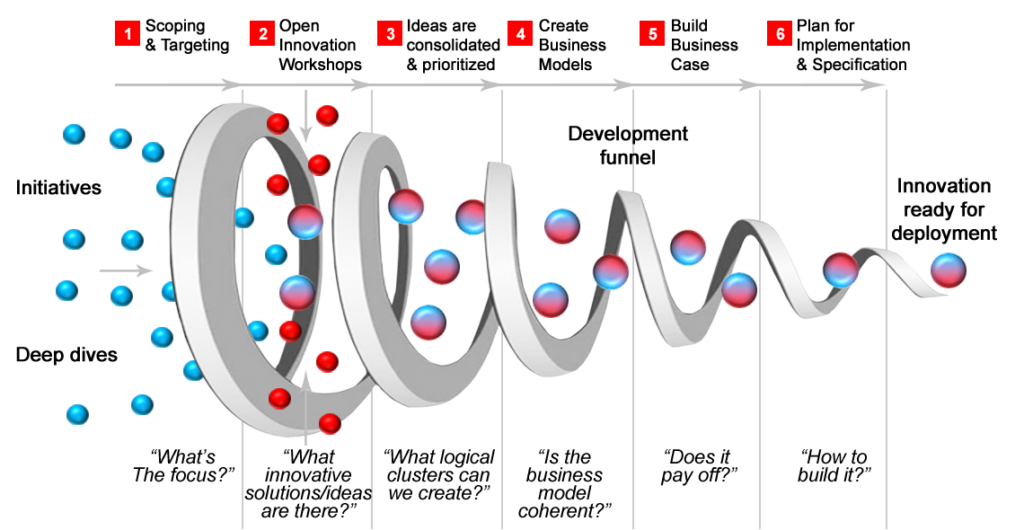
IPG provides platforms to develop ideas and create new opportunities. Starting from the company’s innovation initiatives, in a step-by-step approach, we jointly develop ideas until they are ready for deployment.
- In the first step, deep dive in the company’s existing competencies, knowledge and creative potential are performed to set scopes and targets as guidelines for the entire innovation process. Most promising internal ideas are used as starting points to be further developed and elaborated.
- In the second step, the company opens up to allow external expertise to flow in, challenge and augment internally created ideas. In an Open Innovation workshop set up, key company stakeholders and external experts are brought together to create new ideas, discuss key pain points and answer “blind spot” questions.
- In the third step, all the ideas are gathered, consolidated and prioritized into more structured clusters and concepts. With the focus on the quality of ideas, the filtering process leads to first forms of potential opportunities for the company.
- In the fourth step, qualified and prioritized innovative opportunities are further worked out to develop unique, coherent and sustainable Business Models. They are brought into a concept focusing on value creation for customer whilst covering five most important dimensions: Positioning, Products & Services, Value Chain, Go-to-Market and Earnings Logic.
- In the fifth step, Business Models are translated into Business Cases with in-depth profitability analysis to check for monetary reasoning of the innovation. Alongside value creation for customers, innovation has to bring value capture potential for the company.
- In the final step, the implementation plan is developed to assure innovation is ready for deployment. Only those ideas with comprehensive business logic and economic potential are the ones chosen to be implemented.
IPG Innovative Leaders Network as a source of Open Innovation
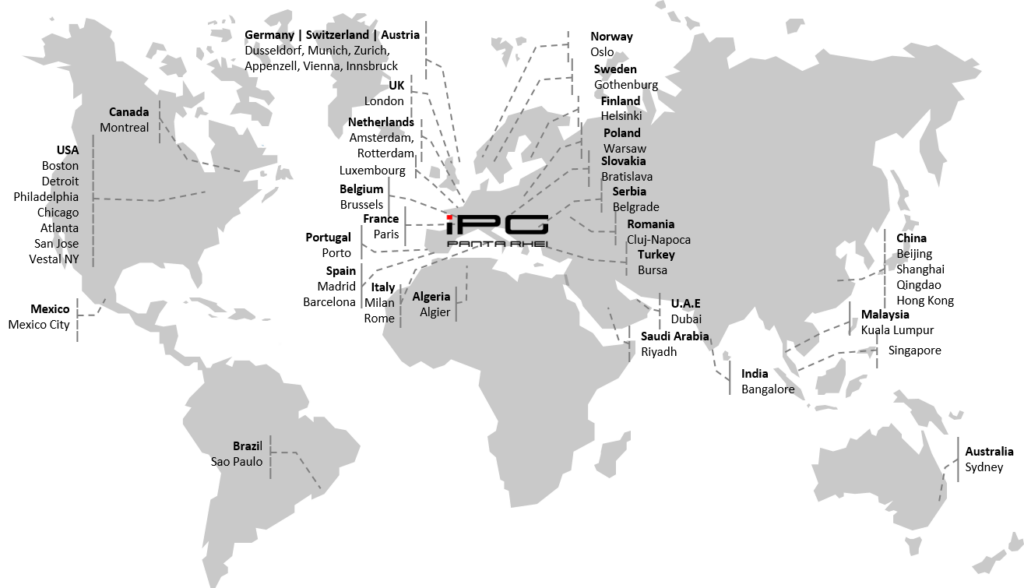
Unique solutions for customers only emerge if one is able to directly access the best minds and specialists available. It is precisely, for this reason, we established IPG Innovative Leaders Network.
The Innovative Leaders Network is our source of Open Innovation, bringing together companies, universities, research institutions, top-level organizations and individuals to connect, share and enable for mutual benefits. We bundle expert knowledge and know-how from all industries and disciplines and take advantage from the different perspectives. Within different formats, we push the current state of research, innovate old business models or develop completely new business logic.
[1] http://www.innovationmanagement.se/imtool-articles/survey-identifies-top-10-innovation-issues/
[2] https://www.innovationleader.com/the-top-10-innovation-issues-to-tackle-in-2018/
[3] https://www.wipo.int/edocs/pubdocs/en/wipo_pub_gii_2018.pdf
[4] http://www.nmit.edu.my/wp-content/uploads/2017/10/Open-Innovation-the-New-Imperative-for-Creating-and-Profiting-from-Technology.pdf