
The impact of digital technology extends far beyond the digital sector itself. This is why the largest digital event in the region, the Second Western Balkans Digital Summit, brought together more than 3.000 participants – policymakers, businesses, startups, research and development community, and civil society organizations to ensure a collaborative approach to policymaking in the digital age. At the Summit, which took place on April 4-5, 2019 in Belgrade, they all had the opportunity to discuss and propose innovative policy approaches, showcase cutting-edge technologies, exchange ideas and discover latest digital trends.
The progress of the EU Digital Agenda launched last June in Sofia, and endorsed by all leaders from the Western Balkans region, was also highly featured. Some of the milestones, such as the EU 30 million euros support for broadband roll-out through the Western Balkans Investment Framework, creation of a 5G corridor between Thessaloniki, Sofia and Belgrade, and more than 1000 regional events carried out through 2018 Code Week, were highlighted. At the center of the Summit was the signing of the roaming agreement among Western Balkans states with the aim to allow its citizens to “roam like at home” when traveling in the region.
The key ambition of the Digital Agenda is to accelerate the pace at which high-speed networks are developed, and help this vital infrastructure rolling out across the region. Better high-speed networks lead to an increase in the number of digital products and services available to consumers, but with these also comes the need for higher levels of online security and trust. This is why the Summit launched open discussions focusing on the following four themes: Digital Skills, Trust and Security, Networks and Connectivity, Digital Economy and Society.
This year’s Digital Summit also featured a Tech Showcase designed to empower the Western Balkans startup ecosystem. Most exciting startups from the WB6 region – in total 38 of them –presented their vision and cutting-edge innovation in products and services that brought them to the new level.
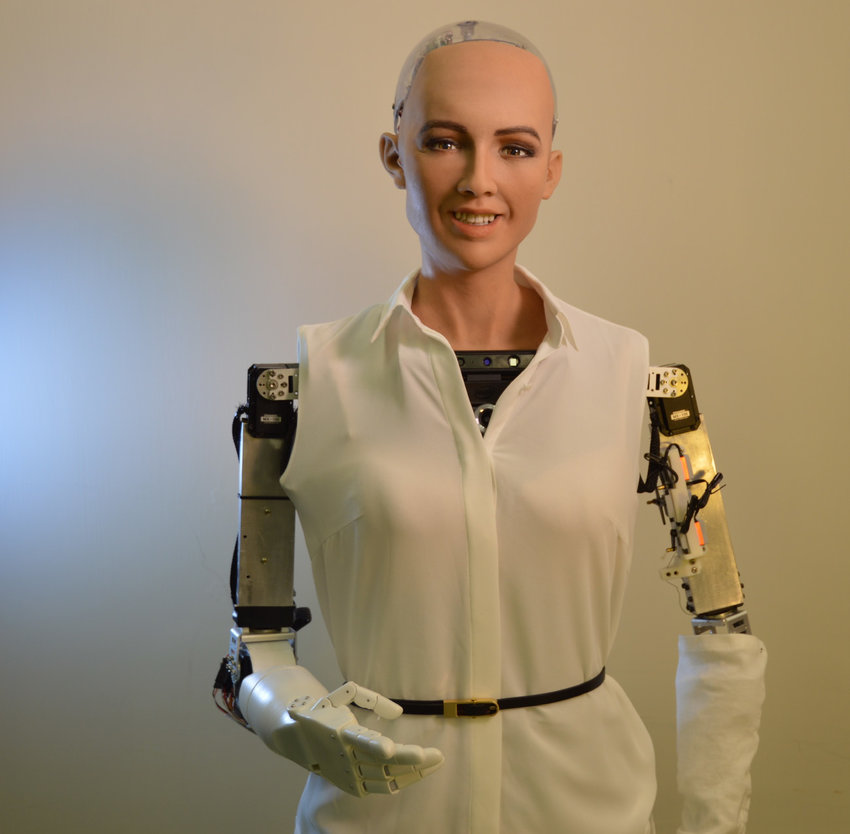
The Summit itself was at the center of the high media attention, also because of its key note speakers. The one that attracted the most interest was Sophia, the Hanson Robotics’ latest human-like robot, and UNDP non-human Innovation Champion. Sophia, which was created by combining innovations in science, engineering, and artistry, showcased the future of Artificial Intelligence as well as a framework for advanced AI and robotics research. She also serves as an agent for exploring human-robot experience in service and entertainment applications.
The interview with Sophia was carried out by Branka Andjelkovic, Co-Founder and Program Director of the Public Policy Research Center from Belgrade, which brings together innovative researchers and digital enthusiasts deliberating on the future of work. The Center has been recognized by its pioneering research on the platform economy workers from Serbia and has been invited to open the First Day Plenary Session of the Summit with Sophia.
The CENTER strongly believes that the future of work should be addressed now should Serbia aim to keep decent work and quality of employment legacies in place. In this vein, the CENTER will organize its second annual conference on the Future of Work in December, while is also preparing a regional conference on the Platform Economy for early 2020. It will be held in Novi Sad, the forthcoming European Capital of Culture. The Conference will be hosted by the Public Policy Research Center with the support of Vrije University from Amsterdam. Its Southeast Europe edition will cover the following countries: Albania, Bosnia & Herzegovina, Bulgaria, Croatia, Macedonia, Moldova, Montenegro, Romania, Serbia, Slovenia, Ukraine.
This unique event will gather 150-200 business partners, international, regional and domestic policymakers, civil society organizations and prominent scholars, to discuss the platform economy in our region, its proximity to the EU and opportunities created by the economic geography which makes this part of the world attractive for businesses in a variety of locations such as the US, Australia or China.