
Gartner's Hype Cycle for Emerging Technologies 2019 focuses on the interaction of man and machine and the integration of artificial intelligence. US market researchers investigated more than 2,000 emerging technologies and derived 5 megatrends for the next ten years.
The US market research institute Gartner has investigated more than 2,000 individual technologies for the current "Hype Cycle for emerging technologies", summarized in 29 categories. The analysts derive five megatrends from 2019 that circle around the interaction of man and machine. According to Gartner, the use of highly developed Artificial Intelligence (AI) systems is decisive for the success of a company.
Gartner reissues the Hype Cycle every year. The analysts divide the use of each technology into five phases: first, the solution is regarded as an innovation trigger, which triggers exaggerated expectations with the first application (phase 2). In phase 3 the crash follows into disillusionment. The technology is then weighed upon an empty stomach (phase 4) and can finally unfold its full potential in phase 5. The analysts base their forecasts on a maximum of ten years.
This year's Hype Cycle is all about the question of how Artificial Intelligence (AI) systems can improve human performance. Technically, the cycle revolves around the IoT, cloud and edge computing.
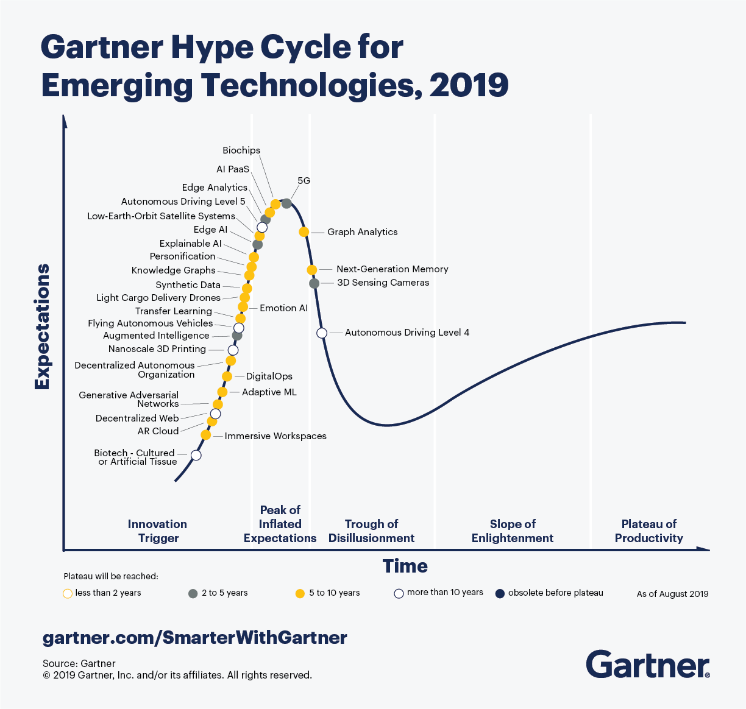
The megatrends of the near future
1. Sensors and mobility: sensors are at the core of the Internet of Things (IoT). Gartner expects a 3D map of the earth to have been produced within ten years. Companies will use physical space to interact with their customers. For this, they should now examine the use of 3D sensing cameras, drones (as deliverers) and autonomous vehicles. Keyword autonomous vehicle: they will also be used in the air in the future.
2. Second "expansion" of man: More and more sophisticated prostheses are replacing or strengthening human limbs. So-called exoskeletons, for example, which workers strap on, seem to give people superpowers while at the same time protecting the spine, joints and muscles. This not only increases the possibilities in production or transport but also helps nurses - and their patients. In the future, the use of biochips and augmented intelligence will also be discussed under the heading "augmented human".
3. Post-classical computing and communications solutions ("Comms"): Post-classical computing is characterized by completely new architectures. Low Earth Orbit (LEO) satellites, for example, reduce the latency of Internet connections worldwide. This will enable private households and companies from previously underdeveloped regions to join in. Technologies such as 5G, Next Generation Memory and Nanoscale 3D printing are of interest to decision-makers in companies.
4. Digital ecosystems: Gartner understands digital ecosystems not only as a combination of companies - originally possibly competitors - suppliers and partners but also as the inclusion of things. The necessary technologies revolve around the decentralized network, knowledge graphs (visualization of structures containing objects and connections), synthetic data (artificially generated data, e.g. to test production facilities and learning models) and DigitalOps (digitized further development of DevOps, an artificial word from Development and Operations).
5 Advanced AI and Analytics: Companies leave traditional BI (Business Intelligence) solutions behind. They work with adaptive machine learning, Edge AI (AI for Artificial Intelligence), Edge Analytics and graph analysis. AI platforms operate according to the As-a-Service Model (AI PaaS).
Gartner assigns each trend to a timeline and efficiency. Thus 5G will have reached a high degree of utilization within two to five years and will have a high impact. The influence of Augmented Intelligence and Edge AI will be even stronger - namely "revolutionary". Gartner also attributes revolutionary potential to the decentralized network. However, this will only become noticeable in more than ten years' time.
Digital ethics trends
The Augmented Reality Cloud (AR Cloud): As a digital content layer, the Augmented Reality Cloud acts as a digital legend of the physical world and will be a core component of the infrastructure in the future. The technology is far from mature, but its effect will be revolutionary. The AR Cloud touches not only on privacy, security and compliance issues but also on digital ethics. Already now Amazon, Apple, Facebook, Google and Microsoft are appearing as providers, but also lesser-known names like 6D.ai and Xperiel.
Decentralized autonomous organizations (DAO): Gartner calls decentralized autonomous organizations "outlaws". Because these digital information objects, which are used to store or process information, are integrated into business processes or other interactions without human intervention. They are based on blockchain and smart contracts and operate completely autonomously across different geographical regions - which is why they evade country-specific compliance requirements.
The advantages of DAOs are the speed and agility they give users. They can contribute to faster and better decision-making. Gartner still sees them in the embryonic stage, but they will also - within five to ten years - have a revolutionary effect. First suppliers are Colony, DAO IPCI, DAOstack and Ethereum.
Augmented Intelligence: Another - somewhat more mystical - the term for Augmented Intelligence is "Kentaur". Comparable to the legendary hybrid of horse and human being, human beings receive quasi-magical powers through the fusion with technology. This "man-machine partnership" can increase physical as well as cognitive abilities. Although the technology is still at an early stage, the degree of utilization is comparatively high. Gartner advises CIOs to focus their efforts on the benefits to the human employee rather than on automation. It is important to address the ethical questions associated with the use of Augmented Intelligence.
Bots with "emotional AI"
"Emotional AI" or "emotional computing": The aim of so-called emotional AI is to use facial and speech analysis or other technologies to recognize the feelings of the human counterpart in order to react more individually to his or her needs. This is interesting for companies when using robots as personal assistants, for example.
Gartner sees emotional computing in a legal grey area at the present time, especially for the EU. The EU Commission recently launched an initiative to discuss ethical issues.
AI PaaS (artificial intelligence according to the platform-as-a-service model): platforms for machine learning and artificial intelligence from the cloud outlines Gartner as AI PaaS. The hype surrounding such solutions will continue to rise, according to analysts. Especially since the market offers mature solutions, well-known players are Alibaba, Amazon Web Services, Baidu Cloud, Google (Cloud AI), IBM with its Cloud and Microsoft with Azure.
Gartner's Research Vice President Brian Burke believes a company's ability to innovate is a key competitive advantage. Given the rapid pace of technological development, Burke notes that even very innovative companies are struggling to keep pace.
The original article was posted in the CIO article.