
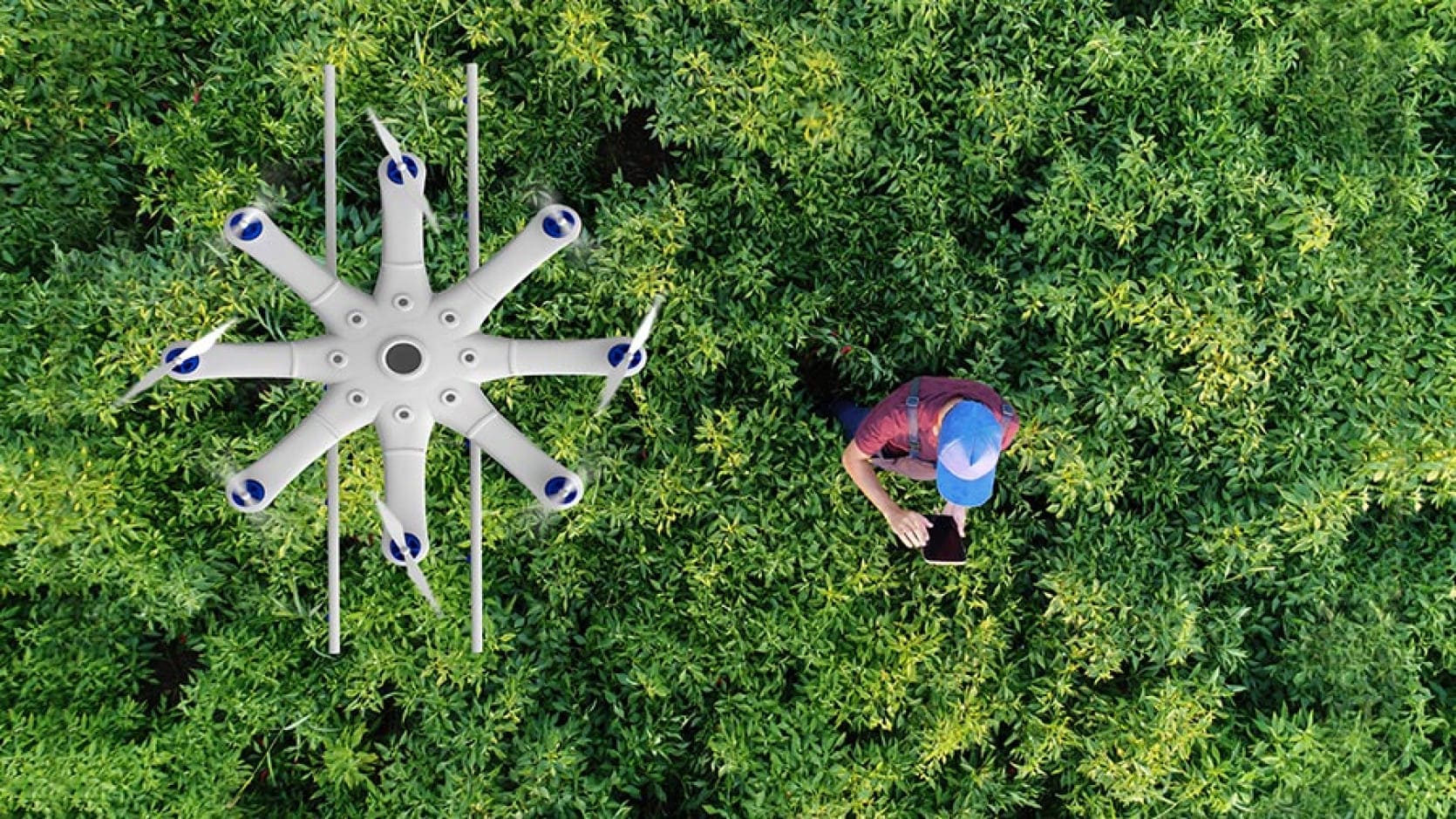
John Deere is not only a manufacturer of large agricultural machinery, but also one of the pioneers in the field of smart farming. We explain how drones, data and sensors are shaping the agricultural sector of tomorrow.
Agriculture is one of the causes of climate change, and at the same time it suffers enormously from its consequences. It does not help that farmers all over the world have to ensure the food supply for a steadily growing world population. The question is: How can we manage the balancing act between sustainability and productivity in the future?
Politically, the EU has set the course for climate-neutral management with its Green Deal. For European farmers, this initially means legal restrictions on their current production processes, such as manure spreading or chemical plant protection. Sustainable alternatives must therefore be found to strengthen confidence in the agricultural sector without undermining the European Union's self-sufficiency options.
The agricultural machinery manufacturer John Deere has three practical approaches from its technological repertoire up its sleeve. They are intended to contribute to solving this complex task - and are already doing so in part. The use of clouds, drones or sensors is not a dream of the future, but is already firmly integrated into many facets of agriculture.
Spreading slurry efficiently with the help of precision farming
Mineral fertilisers will continue to be used in arable farming. It is therefore all the more important to make organic fertilisation with manure as efficient as possible. In this way, overfertilisation should be avoided and mineral fertiliser should only be used where it is absolutely necessary. The buzzword here is precision farming - a combination of analytics and specially developed sensors.
John Deere, together with Agricon, has developed a method for developing fertilisation plans that take into account the individual soil conditions of each sub-area of the field. First, a soil sample is taken per hectare and analysed in the laboratory to determine the nutrient distribution. Based on the laboratory results, a digital nutrient distribution map is then created for basic nutrients such as phosphorus, potassium and magnesium. This can then be used by the farmer - together with the nitrogen content measured directly on the plant - to precisely determine the slurry requirement at each field site.
For the farmer, however, it is not only the composition of the field that is of interest, but also that of the manure itself. Strict regulations require a fertiliser requirement plan that provides information about the amount to be spread and its ingredients. To avoid labour-intensive stirring and sample testing, John Deere offers the Harvest Lab 3000, a near-infrared (NIR) sensor that can determine the most important components of the slurry in near real time and store them directly online on an open data platform (the John Deere Operations Center) for documentation purposes.
Intelligent crop protection thanks to drones, GPS and AI
Chemical pesticides and weed killers do not have a good reputation. They are often suspected of upsetting natural processes and causing lasting disruption. However, they remain indispensable for farmers to safeguard yields, as mechanical alternatives in weed removal, for example, quickly reach their limits. So once again, precision and economy are required in the use of the agents. In particular, double treatment of areas must be avoided and the minimum distance to protected areas (e.g. rivers) must be maintained.
The problem can be addressed by creating so-called application maps based on drone or satellite images before applying the chemicals. On the aerial photos, vegetation differences, stand density and disease pressure can be easily recognised, which makes it possible to plan a precise spraying of the sub-areas. This eliminates the need for large-scale uniform treatment, which benefits the environment.
During the spraying process itself, it is crucial to be able to precisely determine the application location and quantity. John Deere provides nozzles for this purpose that can be automatically switched off while driving using GPS (Section Control) and whose application rate and droplet size can be variably adjusted (Exact Apply). In addition, some of the manufacturer's US crop protection series use the so-called see-and-spray method, in which a camera detects colour differences in the field and uses artificial intelligence to identify weeds, which can then be sprayed automatically.
The digitalisation of planning, execution and documentation steps has not been new for farmers for some time. Against the backdrop of increasing legal and societal pressure, but also due to the noticeable consequences of climate change, it is in the economic as well as the ecological interest of the agricultural sector to further expand existing technologies and to work on new solutions in the field of smart farming.
This article was originally posted by CIO