

In this article we will introduce you to key customer & industry trends, niche innovations in the food sector and display how materiality assessment can prepare you for sustainable strategy development.
In 2023 more and more companies within the food business are starting to develop their sustainability strategies in order to meet the ever-rising expectations of all included stakeholders to contribute towards a greener future.
Customer trends:
Customer trends in the food business sector include a strong focus on sustainability and healthier options, with increasing demand for organic food, popularity of vegan and meat alternatives, and prioritization of sustainability in personal care products, particularly among Gen Z consumers.
Focus on Sustainability and Healthier Options - 71% of grocers cite sustain- ability as a key priority for 2023, 37% are willing to pay a premium of up to 17% for sustainable choices.
Organic Products - Germany has experienced a continuous increase in the demand for organic food. Organic edible oils and organic sauces have been among the fastest growing product lines in supermarkets and benefited from increasing focus among Germans on health issues and sustainability.
Veganization - The popularity of meatless meals and vegan options is rising, especially among younger Germans. German plant-based alternatives no longer focus on a certain demographic. The vegetarian eating trend is also gaining popularity among omnivores who want to cut back on their meat intake but don't want to fully give it up.
Gen Z consumers value sustainability in personal care products as well, but they prioritize it in snacks and ready-made meals more than older generations, with 60% willing to pay for sustainable products.
Industry trends:
Industry trends in sustainability for the food business sector include increased supplier collaboration to address emissions in the meat and dairy categories, rising adoption of plastic-neutral schemes, and adjustments in business models by food retailers to promote refillable options and reduce plastic use.
Supplier collaboration to solve emissions for sustainability - ~50% of value chain emissions of grocers are in the meat and dairy categories.
Plastic Footprint - plastic continues to be a very controversial topic in the supermarket industry. Adoption rates of plastic-neutral schemes are going to rise in 2023.
Retailer Developments - This year should see sustainably-minded food retailers and supermarkets adjust their business models. In particular, this will be seen with supermarkets making room for refillable options, selling unpackaged foods, and developing plastic-free zones in their stores.
Delivery and Zero Waste – With increasing awareness of environmental protection in broad sections of the German population, new business models are emerging and scaling rapidly. A new wave of impulse grocery delivery services is appearing and scaling quickly as well. Companies are now offering deliveries within 10 minutes of ordering for a small fee. As for, supermarkets, there is a lot of potential to incorporate these new types of services into their broader brand offering.
Niche Innovations in Food Industry:
22 niches were selected which are most likely to have a systemic integrated sustainability potential. SWISS-IPG has identified 9 of them to have a great impact on sustainable food development of the future, and those are:
- Agroecology schools
- Alternative packaging materials
- Digital farming
- Insect food products
- Market gardening
- Re-/Upcycling of food waste
- Regenerative agriculture
- Solidarity table
- Sustainable water cycles
If you want to find more in detail about these niche innovations, please check our full report “Sustainability in Food Business 2023".
Materiality Assessment:
Materiality assessment can guide businesses through their sustainability strategic planning processes. Social, governance, economic, and environmental challenges that have a direct or indirect influence on a corporation are considered material sustainability issues. As a result of different circumstances, they will differ for each given organization depending on their size, product kinds, location, etc., thus businesses must go through their own process to define tailored priorities.
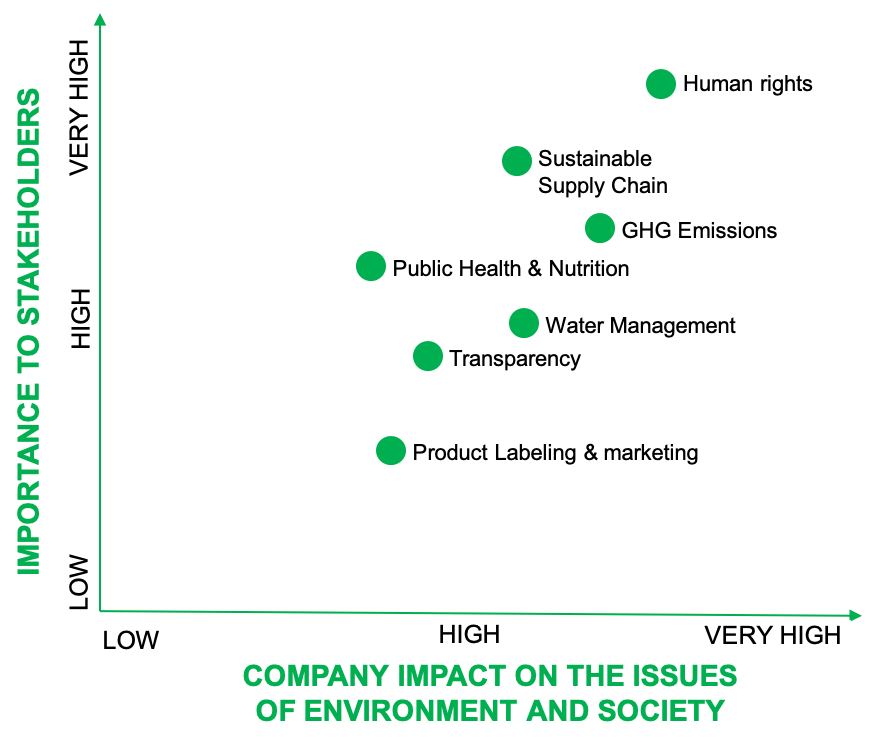
IPG has reviewed different materiality assessments and has identified the most important sustainability topics:
- Human Rights
- Sustainable Supply Chain
- GHG emissions
- Water Management
- Public Health & Nutrition
- Transparency
- Product Labeling & Marketing
These topics are usually scattered on the matrix with importance to the stakeholders as vertical index and importance to the ESG commitment of the company index on its horizontal side.
Author:
Vuk Jakovljević
Business Analyst @ Swiss IPG Partners Group