

This is how the results of the Transformation Study 2023 can be summarized. When asked about the reasons for starting their transformation projects, most respondents cited reorganization reasons. In second place, cost reduction was named as the objective for this transformation.
There is a very big difference between America and Europe. Whereas cost reduction is by far the main motivation for the transformation in Germany (1st place with 52%), it plays a much smaller role in America, where it was ranked 8th with 31%. In Europe, the transformation was expected to make a relevant contribution to cost reduction everywhere. In all countries, cost reduction was therefore at least the second reason for starting the transformation in the first place. To prove this, it is also helpful to ask the study what the expected consequences would have been if the transformation had not been carried out. The answer: "higher costs" was consistently ranked number 1 in Europe. Here, the American respondents are in agreement with the Europeans. They, too, expected rising costs quite far ahead (2nd place). Managers in the USA are only more afraid of incompatibility with the latest technologies (at 53% in first place, even ahead of cost increases at 50%).
Were the transformation goals achieved?
Across all regions, 63% of respondents said they had fully met their targets. For 36% of respondents, the goal was partially met, while only 1% said they had not met the goal at all.
The USA performed best here, with 82% of companies there achieving their target in full. The UK came second by a wide margin in terms of target achievement. The Nordic countries followed with 59%.
This figure is lowest in the DACH region. Here, it is only 55% who have fully achieved their transformation goals!
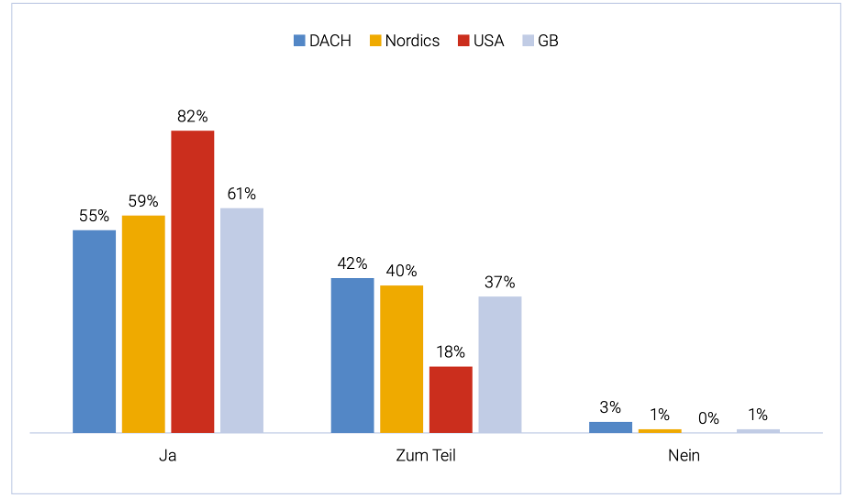
Figure: Achievement of transformation goals
Why the goals were not all achieved? A few clues could be given by the following interpretations
The transformation was underestimated!
Another finding runs like a red thread through the Transformation Study 2023: The technical implementation of the transformation, i.e., the switch to new processes, systems and platforms, is still underestimated by many companies. Even at the planning stage, most of the executives surveyed recognize that the complexity of the project is challenging. The lack of human resources and the likewise lack of know-how also posed the greatest challenges during planning. Companies were apparently particularly surprised by the lack of transformation expertise in their company and the scarcity of resources in the project itself. Poor data quality, together with the lack of resources, ranked second among the unpleasant surprises in the transformation process. The question of what the respondents would do differently or better if they had to do it again could hardly be clearer in showing that the task was overestimated. In the top three places were the resolutions for the future "to plan more resources", "to plan more time for the project" and "to deal with the transformation project earlier".
Housekeeping is crucial success factor for successful transformation
Anyone who has to move their household is forced to take stock. What do I have? What must go with me? What can go? The situation is no different for companies that want to adapt processes, introduce new systems and platforms. When asked what the most important success factors of their transformation were, respondents answered "testing data quality" and "taking inventory." The importance of taking stock and increasing data quality in the transformation project highlights how much companies struggled with data quality in the project. This is the only way to explain the fact that, when asked what surprised them most in the course of the transformation project, the respondents named poor data quality. In Germany, it even took first place by far among the unpleasant surprises, at 35%. This is less surprising when one looks at the answers to the question about the age of the systems before the transformation. Here it can be seen that Germany has held on to old systems the longest.
Transformation know-how is a key resource
One thing is clear from many of the responses to the study: there is a lack of resources and know-how. Across all countries, a lack of transformation know-how is the most unpleasant surprise of the transformation project behind the respondents. Almost 40% confirm this! In the USA, it is even 50% of the companies. When we asked which organizational task was critical to the success of the transformation project, 46% of respondents answered "build new competencies." This was the top value for this question. In the DACH region, the figure was as high as 54% (Germany 57%). 33% of all companies surveyed had to call in external consultants. In the USA, as many as 51% needed external help. The larger the transformation project, the more frequently consultants were called in. When asked what the biggest challenge in transformation planning was, 37% of respondents answered "managing human resources." Approximately 30% already had problems providing the know-how for the project during planning.
Cloud services are spreading in leaps and bounds
61% of companies said they are now using more cloud services as a result of their transformation project. Here the data varies by region. While Nordic countries are only 50% using more cloud services as a result of their transformation, the figure for the US is 81%. Unfortunately, we have no insights into the level from which this increase occurred in the respective regions. Nevertheless, it clearly shows one thing: even in the case of the biggest cloud skeptic in our survey, Switzerland, 48% of companies are already using more cloud services after their transformation than before. Analysts confirm the trend, which our study also clearly shows. IT goes Cloud.
Crises accelerate transformation
We wanted to know whether the events of the last few years (Corona, Ukraine war, energy crisis, inflation) had an impact on planned transformation projects. Across all countries, 35% of respondents said that transformation projects had been prioritized higher or brought forward due to the political turmoil. Very few postponed projects. For 30%, developments in recent years have had no impact on the roadmap at all. The political events in the USA (46%) and the UK (42%) had a particularly positive effect on the transformation. In the DACH region, the political challenges of recent years had the least effect on the transformation agenda. Nevertheless, more than 1/3 of all companies have brought forward or given higher priority to their transformation projects in the wake of the political crises. It can be assumed that, above all, cost increases due to high inflation should be countered by measures to reduce spending. The partial closure of stores and production companies in the wake of the Corona pandemic will have additionally increased the pressure on innovative business solutions.
Hardly any chances for short business interruptions
Major system conversions usually entail business interruptions. How large these will be depends on many parameters. Does the changeover take place in a big-bang process, in many small steps or in a few large ones? Do I start from scratch, simply transfer all processes and data to the new system, or do I engage in selective data migration? Either way, there's bad news for enterprise project teams. Nearly 20% of all companies confirmed that they cannot afford any business interruption at all without suffering noticeable consequences to business operations. Another 30% can only imagine a few hours. This means that for 50% of companies, the window for changeovers due to transformations is no more than a few hours. In the DACH region, this figure is as high as 57%. This can certainly be explained by the strong, internationally successful SMEs in this region. Companies that produce and distribute around the clock or globally have greater challenges than regional champions. Again, nearly 30% can imagine at most a weekend of downtime at this point without putting business operations in real trouble. We will continue to monitor this figure in studies over the next few years. The window is expected to shrink further.
Essence of the 2023 Transformation Study
The essence of this year's study is that companies' transformation projects suffer primarily from a lack of preparation, a tight market for consultants, too few qualified personnel and a shrinking window for business interruption. Nevertheless, despite some obstacles, the majority of the companies surveyed were able to achieve the objectives and expectations attached to their transformation, which is clearly demonstrated above all by efficiency gains and cost reductions.
This article was originally posted by: NTTDATA